
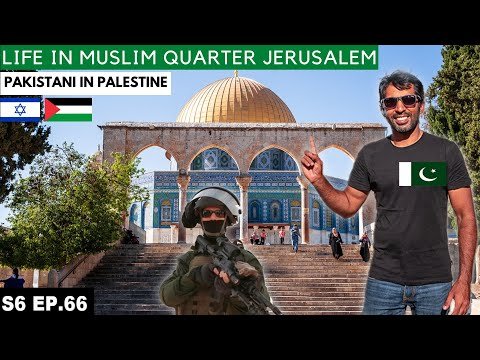
Exploring Jerusalem’s Muslim Quarter: A Journey Through History and Faith
Jerusalem. The name itself conjures images of ancient history, deep spirituality, and vibrant culture. Among all the cities I have had the privilege to visit, this one holds a uniquely special place. Each visit, from my first in 2019 to my most recent, reveals a layer of beauty and heritage unmatched anywhere else.
The Old City of Jerusalem is, in my opinion, the most beautiful old city in the world. This time, my journey took me on an immersive walk through its heart, focusing specifically on the bustling Muslim Quarter, a place where history breathes and daily life unfolds against an ancient backdrop. Join me as we explore its captivating streets, vibrant markets, and sacred sites.
Arrival at the Gates of History
My exploration began on Nablus Road, just outside the Old City. As its name suggests, this road leads directly to the city of Nablus. Crossing it takes you instantly into a different era, right into the Old City’s embrace. Even before passing through the ancient walls, a small Arab souq thrives here, offering a glimpse of the lively atmosphere to come.
Here, you find an abundance of fruits, fresh vegetables, and delicious bread. I spotted a vendor selling a special type of ring-shaped bread, a form I haven’t encountered in other places. Nearby, massive falafels caught my eye—larger than any I’d seen before, testament to the rich culinary traditions of the region.
The journey into the Old City itself is through one of its eight historic gates. Seven of these were constructed during the Ottoman era, while the eighth, the New Gate, dates to 1890. Standing before the Damascus Gate, considered the most beautiful and well-preserved among them, you feel the weight of centuries. These formidable city walls, too, are a product of the 16th-century Ottoman ruler, Suleiman the Magnificent, a true architectural marvel.
The Vibrant Heart of the Muslim Quarter Souq
Stepping through Damascus Gate, you immediately find yourself amidst another bustling market. Stalls line the passage, overflowing with fruits and vegetables brought directly from local fields. I saw piles of grapes and fresh mint, adding to the sensory richness of the surroundings.
This is the souq of the Muslim Quarter, by far the most vibrant and lively market I’ve experienced. It pulses with an energy unique to this place, an atmosphere largely unchanged by time. Vendors spread their wares directly on the ground, selling everything from colorful prayer mats and traditional Arabic clothes to everyday garments.
The sheer number of tourists contributes to the souq’s vibrancy, encouraging shopkeepers to maintain their traditional businesses. While you’ll find modern items, there’s also an abundance of local fruits, sweets, and tempting shawarma restaurants catering to both visitors and residents.
Walking through these narrow streets truly feels like stepping back a thousand years. The air hums with a unique blend of commerce and history. Everywhere, you notice security cameras, a modern contrast to the ancient stone, reflecting the city’s complex reality. Despite this, the experience is incredibly unique and amazing.
The Muslim Quarter is not exclusively Muslim. It’s a remarkably diverse area where you encounter Arabs, numerous tourists, and Jews. I even spotted the first Armenian Church within the Muslim Quarter, a testament to the coexistence of different faiths. Similarly, you can find mosques within the Christian Quarter. However, seeing Israeli flags displayed outside some houses in this Palestinian area, where Jewish residents reside, does highlight the city’s ongoing tensions, a situation that always remains on edge.
Journey to the Al Aqsa Compound: A Sacred Space
Navigating the increasingly narrow and busy streets, even observing motorcyclists expertly weaving through the crowds, brought me closer to the Al Aqsa Mosque. Approaching the compound, I encountered Israeli forces on duty. Despite feeling a certain rudeness in their demeanor during a bag check, it’s part of their protocol in this sensitive area.
This reality is particularly challenging for local Arabs, many of whom require special permission or identification to enter. It highlights the restrictions faced by people living in neighboring areas, even those just a short distance away. After passing one checkpoint, another typically awaits before full entry.
Upon reaching the gate of Al Aqsa Mosque, I was amazed when the personnel recognized me from my Friday prayer visit the previous day. It’s remarkable how they track visitors, even among thousands, demonstrating the meticulous observation of the site.
The Al Aqsa Compound, also known as Al Haram Al Sharif, is more than just a religious site; it’s a place of profound emotional connection for many. Families gather under the trees, sharing meals and spending quality time, especially on crowded Fridays and Saturdays. It’s a beautiful place to reflect and connect.
Unveiling the Al Aqsa Compound: Dome of the Rock and Qibli Mosque
The compound itself features eight gates, seven of which are typically open, with most located within the Muslim Quarter. From a vantage point, the magnificent view of the entire compound unfolds, dominated by two extremely significant structures.
The Golden Dome: Qubbat al-Sakhra (Dome of the Rock)
Immediately captivating is the Qubbat al-Sakhra, or Dome of the Rock. Its Arabic name, Qubbat al-Sakhra, literally means “Dome of the Rock,” while “Qubbat” also implies “gold,” referencing its stunning golden dome. It is truly the Golden Dome, visible from a great distance.
This site is deeply significant to both Jews and Muslims. Jews consider it the holiest place on Earth, believing it to be where God created the world and where Prophet Abraham brought his son for sacrifice. It was also the location of their First Temple, built by Prophet Solomon, and the Second Temple, built by King Herod and later destroyed by the Romans. For Jews, even when the temple stood, only the High Priest or Rabbi could access this most sacred spot, hence their practice of praying at the Western Wall, 40-50 meters away, facing Jerusalem.
For Muslims, it is the place where Prophet Muhammad made his Night Journey before his ascension to heaven, and it served as the first Qibla (direction of prayer) before it was shifted to Makkah.
Stepping inside, you encounter arguably the most beautiful interior in the entire area. The artwork and mosaic work on the walls are breathtaking, a masterful blend of green, gold, blue, and red. Tinted windows add to the mesmerizing play of light and color. The central feature is a large stone, around which all the religious narratives converge, with a narrow passage leading to a prayer space below.
Historically, the Dome of the Rock has seen many transformations. Built during the Umayyad period, it was rebuilt in the 11th century after an earthquake. Crusaders converted it into a church, but after Saladin’s conquest, it reverted to Muslim rule. Its octagonal structure and the impressive blue tile work are Ottoman additions, featuring calligraphy from two chapters of the Quran, Al Isra and Yasin.
The iconic golden dome itself hasn’t always been gold. In the 1960s, a collaboration between Turkey and Jordan led to its renovation. The dome, originally made of aluminum or similar material, had discolored. It was then coated with liquid gold, ensuring its brilliant and beautiful appearance that radiates across Jerusalem today.
The Historic Qibli Mosque (Al Aqsa Mosque)
Close to the Golden Dome stands the Qibli Mosque. This is the structure many people refer to as Al Aqsa Mosque, though “Al Aqsa” actually encompasses the entire compound. This mosque is a major gathering place for prayers, and its interior is frequently depicted in images of the site.
Its foundations were laid by Caliph Umar when Muslims first conquered the area. It was expanded by the Umayyads, later rebuilt by the Abbasids after an earthquake, and even served as an army depot during Crusader rule. However, under Saladin and the Ottomans, it underwent significant renovations, restoring it to its spiritual purpose.
Inside, the mosque reveals a unique and beautiful architectural style. The Umayyads, whose power base was in Damascus, influenced its design, giving it resemblances to the Umayyad Mosque in Damascus. Some architectural elements may even draw inspiration from Byzantine church styles. The artwork within its dome is unparalleled, a high-quality masterpiece that, even after centuries, leaves visitors in awe.
A particularly unique feature is the Pulpit of Saladin, an almost 1000-year-old artifact. Crafted from wood and ivory, it showcases exquisite, detailed artwork and is carefully preserved.
During my time inside, I met Mahmood, a local from Bethlehem, just 15-20 kilometers away. He shared the poignant reality that despite living so close, he cannot visit this deeply revered site without a visa due to a separating wall and strict restrictions. Mahmood’s visa, tied to his work in Jerusalem, grants him this rare access. It’s a stark reminder of the challenges faced by many, even from nearby cities like Ramallah, who require visas to visit a place holding such profound religious and emotional significance in their own land.
Al Aqsa Qadeem: The Ancient Undercroft
Beneath the Qibli Mosque lies another mosque, Al Aqsa Qadeem. While its exact history is somewhat obscure due to numerous renovations and earthquake damages over centuries, it’s believed by some to be the original structure, with the upper mosque built later. Today, this elongated, tunnel-like space, featuring ancient large stone blocks and old columns, serves as an institute for children to learn the Quran.
The Dynamic Management of a Sacred Site
The Al Aqsa Compound is currently under the control of a Palestinian-Jordanian body, a situation established after Israel captured it in 1967 and then transferred internal control to this body. While Muslim management handles all internal affairs, the presence of Israeli army personnel is constant, both outside and sometimes inside the compound.
This dynamic ensures constant vigilance. Tensions, unfortunately, erupt a few times each year, leading to increased military presence. Yet, even during calmer periods, the army remains alert at check posts, monitoring the situation, reflecting the complex and sensitive nature of this extraordinary place.
My journey through Jerusalem’s Muslim Quarter and the sacred Al Aqsa Compound offered an unparalleled insight into a place where ancient history, vibrant culture, and profound faith intertwine. It is a city that never ceases to captivate, leaving an indelible mark on every traveler who walks its hallowed streets.